Mindful Crafting: How Art Can Reduce Stress & Improve Mental Health
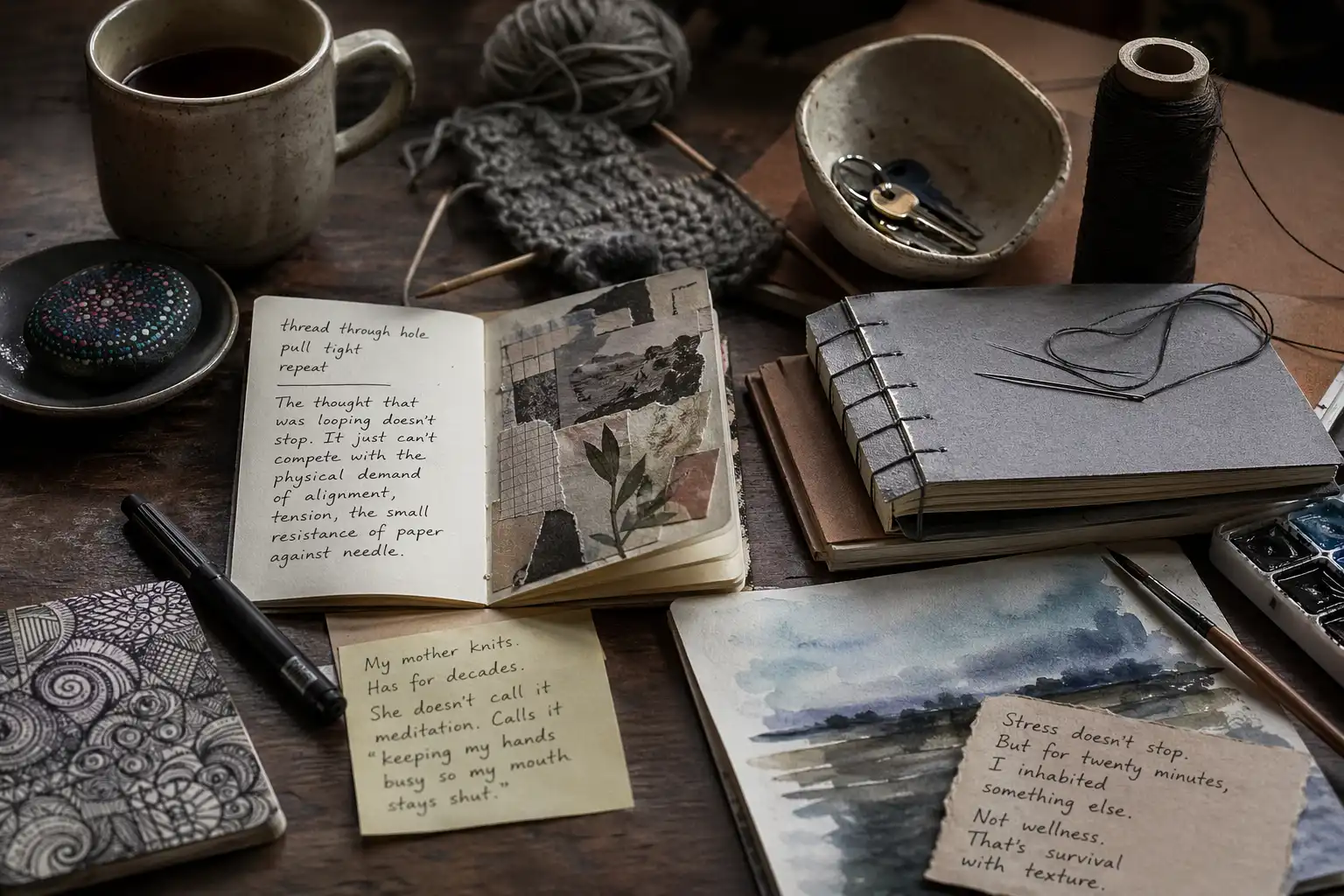
I don’t believe in mindfulness. Or I didn’t. The word sounds like an app subscription, a scented candle, something purchased to fix a life that won’t be fixed. But I believe in what happens at 6 AM when I’m binding a sketchbook with needle and thread, not because I need a sketchbook, but because the repetition is the only quiet my head gets.
That’s what this is about. Not wellness as product. The actual experience of making things when your mind won’t stop.
What Actually Happens
The science is real, I suppose. Cortisol, flow states, right-brain activation. But those words don’t capture the specific moment: thread through hole, pull tight, repeat. The thought that was looping—an email, a conversation, tomorrow’s problem—doesn’t stop. It just can’t compete with the physical demand of alignment, tension, the small resistance of paper against needle.
My mother knits. Has for decades. She doesn’t call it meditation. Calls it “keeping my hands busy so my mouth stays shut.” Her blood pressure is low. She doesn’t know why and doesn’t care. The rhythm is the point, not the explanation.
The Product Problem
“Mindful crafting” as marketed insists the product doesn’t matter. This is a lie we tell beginners so they won’t be intimidated. The product matters. Not because it needs to be good, but because completion creates a specific feeling—dopamine, if you want the word—that incompleteness doesn’t.
I have a drawer of abandoned projects. Half-painted stones. A scarf with dropped stitches I couldn’t find. A collage missing one element I never located. They don’t soothe me when I discover them. They accuse. The finished sketchbook, the lumpy but complete scarf, the painting that surprised me—they’re evidence. I was here. I made this. The loop stopped long enough for something to exist.
Specific Crafts, Specific Effects
Not a guide. Observations.
Watercolor: Unforgiving. The bloom spreads where it wants. I fought this for months, trying to control it. Then stopped. The acceptance transferred—not to life, I’m not that naive—but to other materials. Some things cannot be corrected, only incorporated.
Knitting: My mother was right about the rhythm. But she didn’t mention the terror of realizing you’ve made a mistake twenty rows back. The choice: undo hours, or incorporate the error. Both teach something. Neither is relaxing in the moment.
Doodling: I do this in meetings where I’m supposed to be present. The contradiction is the point. My hand moves so my mind can listen. Zentangle patterns, repetitive lines, the same spiral until the page edge. I have notebooks full of these margins. No one was meant to see them. That privacy is essential.
Mandala stones: Tried once. The dots require breath control I don’t have. Gave up. The half-painted stone sits in my garden, weathering. Sometimes I notice it. The imperfection is visible from space.
Collage: Old magazines, scissors, glue. The smell of adhesive is childhood. I make these when I’m sad, not anxious—there’s a difference. Sadness wants memory, texture, the past rearranged. Anxiety wants repetition, rhythm, the present occupied. I choose materials according to the problem.
Clay: The only craft that genuinely quiets my mind completely. Too sensory. Too demanding. I made a bowl that leans. It holds keys by my door. Every time I drop them in, I feel the leaning and remember the hour I wasn’t thinking about anything else.
I should mention this, since the original did. Artkul.com sells supplies. Kits arrive at your door. Workshops happen. Community exists.
I’ve bought their watercolor set. The brushes were better than I expected, the paper adequate. The “mindful workshop” I attended was a woman demonstrating technique while talking about breathing. I ignored the breathing advice. Learned a wet-on-wet method that changed my sky paintings. Value received, different from value advertised.
The community aspect: I posted one painting. Received three comments, one from someone in Pune who also couldn’t sleep. We don’t correspond. But I remember their username. Small connection, not friendship. Enough.
How to Actually Start
Not a framework. What worked for me:
Don’t choose intuitively. That’s pressure. Use what you have. Toothbrush and coffee grounds for mark-making. Cardboard from delivery boxes. The constraint creates decision, which is already creative.
No dedicated space. I work on the floor, the bed, the kitchen table. The ritual is the making, not the location. Though I do keep supplies visible—paint tubes on a shelf, not in a drawer. Out of sight really is out of mind. The original article got this right.
Time boundaries are useful but flexible. I set a timer for twenty minutes, ignore it if I’m engaged, stop anyway if I’m not. The timer is permission to begin, not obligation to continue.
Sensory check-in: I tried this. Noticed the brush weight, the paper smell. Felt self-conscious, performative. Stopped. The sensation arrives naturally or not at all. Forcing awareness becomes another task.
Release judgment: Impossible. I judge everything I make. The practice is making anyway, not judging less. The judgment becomes familiar, less authoritative, like a roommate you learn to ignore.
What Sustains
Linking to routine: I draw after the morning tea cools to drinkable temperature. Not before, not after. The tea is the signal.
Photographing work: I do this, but not for growth documentation. For evidence that I was present in a specific hour on a specific day. The photos are timestamps, not portfolio.
Community: I don’t have one. The online posting is enough. In-person craft circles made me anxious—comparison, performance, the need to be pleasant while working. Solitude suits me better. The original article assumes community helps everyone. It doesn’t.
Inspiration: I don’t wait for it. But I also don’t force daily practice. Some weeks I make nothing. The absence creates pressure, then release, then return. The rhythm is irregular. That irregularity is also the practice.
The Real Conclusion
Stress doesn’t stop. I still wake at 3 AM with tomorrow’s problems rehearsing themselves. But I also know that at 6 AM, I can bind a sketchbook, thread through hole, pull tight, repeat. The problem won’t be solved. The loop won’t be broken permanently. But for twenty minutes, I inhabited something else. My hands were busy. My mouth, if not shut, was at least silent.
That’s not wellness. That’s survival with texture.
Artkul sells the supplies. The rest you do yourself, imperfectly, with judgment, without flow states sometimes, with clay under your fingernails and abandoned projects in drawers and one leaning bowl by the door that holds your keys.
More Canvas & Insights