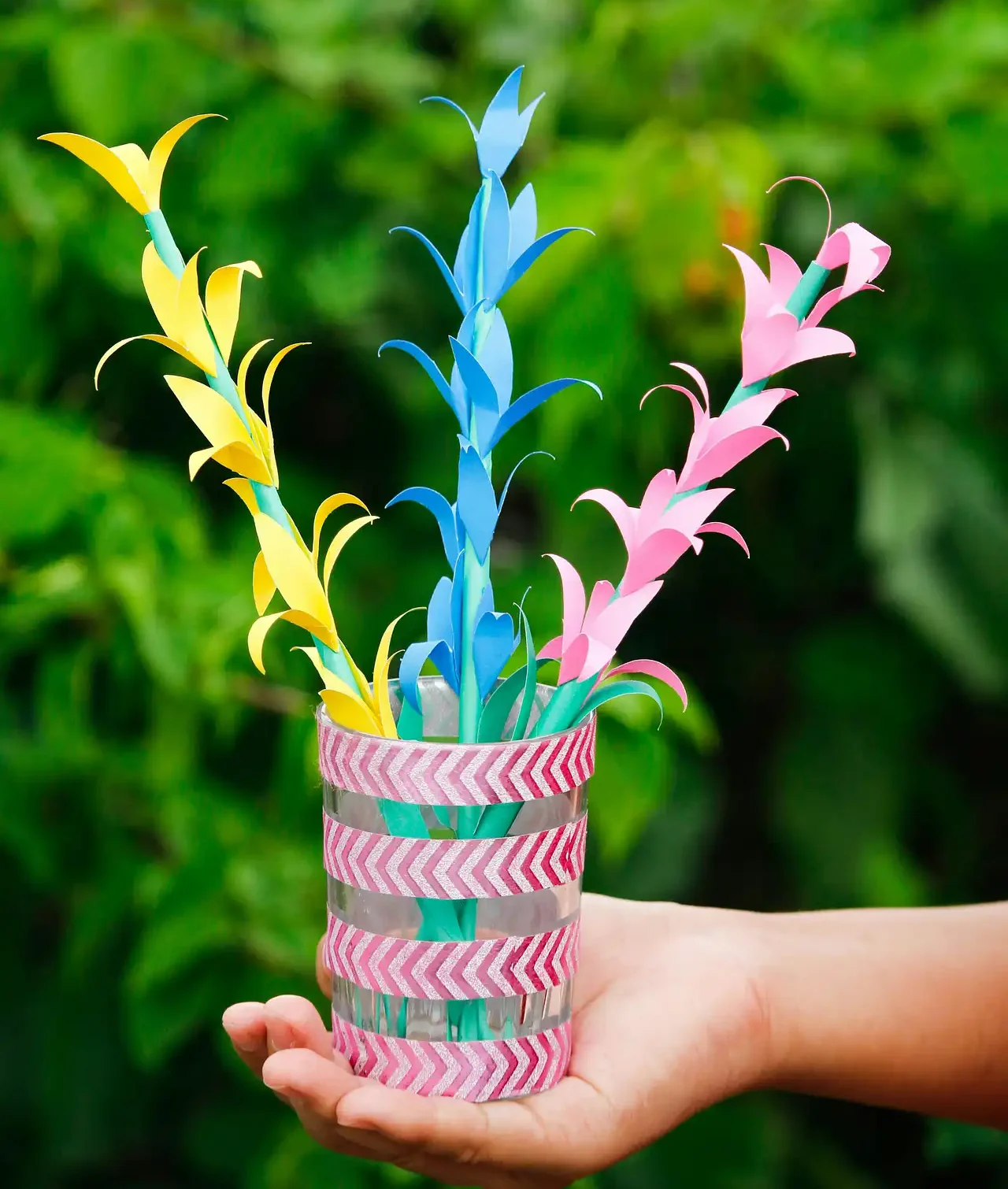
Paper seems too simple, right? That’s the trap. I’ve seen kids walk in looking disappointed—”We’re just using paper?”—then three sessions later they’re obsessing over GSM weights and grain direction. Last month, a father from New Barrackpore stayed after pickup to show me photos of his daughter’s bedroom. She’d covered an entire wall with paper flowers, all gradients she mixed herself using watered-down poster colors. Started with our basic rose template. Now she’s designing her own.
At ARTKUL drawing school in madhymagram, we watch this happen regularly.
What 3D Paper Crafts Actually Means Here
Not origami. That’s folding only, no cutting. Not papercraft kits with pre-drawn lines. We teach structural thinking—how flat becomes dimensional through scoring, folding against the grain, tab construction, layering for depth.
Ankita brought in architectural models from her college days to show what’s possible. Students touch them, see the hidden supports inside, understand that “floating” elements need armatures. Then they start smaller. A lot smaller.
What Actually Happens in Class
We begin with destruction. Seriously. Students take good paper and deliberately fold it wrong, cut against the grain, glue messily. They need to see failure before they fear it. Riya, eight years old, cried when her first box collapsed. By session four, she was the one explaining to a new student why his tabs were too narrow.
Scoring tools matter more than scissors. We use bone folders, empty ballpoint pens, even dried bamboo sticks from the local market. The crease quality determines whether your structure stands or slumps. Students learn to listen for the sound—paper fibers breaking slightly, that specific crackle that means the fold will hold sharp.
Glue is its own lesson. Too much, and paper warps. Too little, and joints fail. We start with white glue and brushes, move to double-sided tape for precision work, eventually hot glue for armatures (adults only, obviously). The smell of white glue and newspaper reminds me of my own school days. Students either love it or hate it. No middle ground.
Specific Projects That Actually Work
The “impossible triangle”—looks 3D from one angle, collapses into flat strips from another. Teaches forced perspective and careful measurement. Frustrating until it isn’t. Then it’s magic.
Layered shadow boxes. Students bring personal objects—ticket stubs, pressed flowers, small photographs. We figure out how to suspend them at different depths using hidden cardboard struts. One boy from Barasat made a cricket stadium scene. Three weeks of evening sessions. His mother said he stopped asking for phone time completely during that period.
Paper mechanisms—simple levers, rotating wheels, basic pop-ups. Not engineering-precision, but enough to make a card that actually moves when opened. The “wow” moment when a student first pulls a tab and something rises up never gets old. Even teenagers grin.
The Surprising Students
Not just kids. We get adults who need something that isn’t screens. Like the pharmacist from Sodepur, hands shaking slightly from years of precise pill counting. Paper craft steadied them. Not immediately—first two sessions were rough. But the repetitive scoring, the deliberate slowness, helped. She makes paper jewelry now. Sells at a local fair.
College students building portfolios for design school. 3D work photographs well, shows spatial thinking. One NIFT aspirant constructed a miniature retail display entirely from paper—showed concept without materials cost. She got in.
Parents and children together. Saturday morning “family batches” we started in 2022 because of pandemic demand. Still running. The dynamic changes when adults compete with their own kids. Healthy, mostly. Sometimes we separate them for final projects because the tension gets real.
The Messy Reality
Paper cuts happen. Always. We have band-aids, antiseptic, and a specific “pressure and wait” technique to stop bleeding without ruining work. Students learn to work around injured fingers. It’s oddly proud-making.
Storage is chaos. Half-finished projects, scraps that “might be useful,” failed attempts someone refuses to trash. Ankita does a monthly “harvest”—salvaging good paper from disasters, clearing space. Students hate this. Then they love the clean table.
Tools disappear. Scissors, especially. We mark handles with nail polish, assign specific tools to regulars, but there’s always a moment of hunting. It’s part of the ritual now.
What We Don’t Do
Pre-cut kits. The learning is in the measuring, the mistake, the adjustment.
Competitive “best project” judging within class. We do exhibitions, but in-class comparison kills the beginners. Ankita’s rule: comment on technique, not “prettiness.”
Rushed completion. Some students need four sessions for one complex piece. Others finish fast and start something new. Both are fine.
Is This For You?
If you want instant results, buy a 3D printer. If you want to understand how flat surfaces become space, how your hands can think, come here.
The 3D Paper Crafts sessions run Wednesday afternoons (mostly younger kids), Friday evenings (mixed), and Sunday mornings (adults and families). Materials provided for trial class. After that, students usually want their own tools—specific preferences develop quickly.
Call +91 62910 04807. Tell Ankita if you’re bringing a child, coming alone, or want family batch info. She’ll suggest the right slot and warn you about the glue smell.