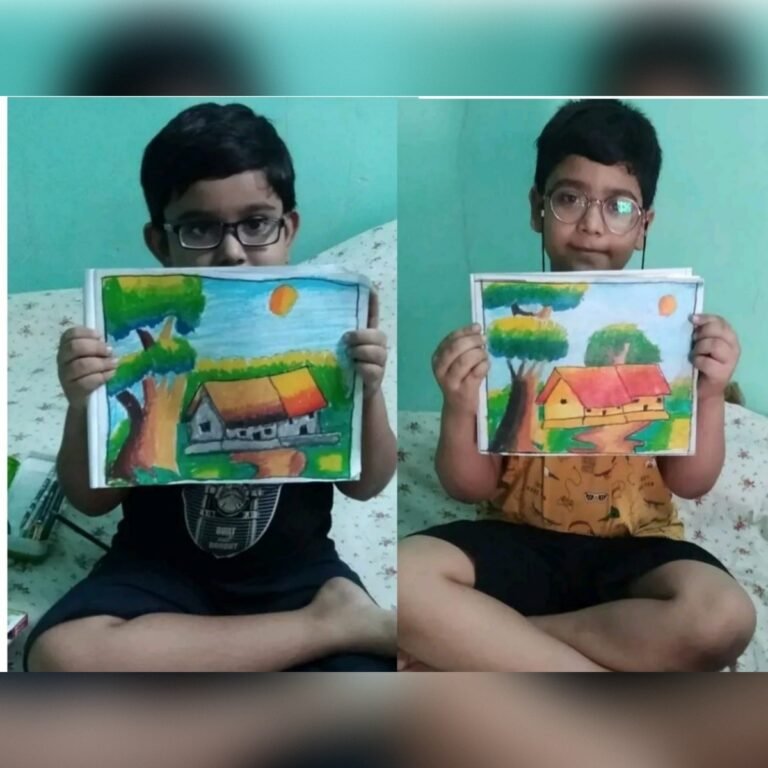
This Small Drawing School Is Changing Kids’ Lives: The Story of Artkul Academy
The stairs smell like turpentine and old rice. You climb past a stationery shop where the owner sleeps behind the counter, past a door that doesn’t close properly, into a room with windows that won’t open but let in enough light to see charcoal dust on the floor. This is where it happens. Not a “quiet corner of the community.” A specific room above a specific shop in Madhyamgram, North 24 Parganas, where the auto horns filter through the glass and the ceiling fan wobbles.
What Actually Happens When They Arrive
Riya, seven, first day: wouldn’t pick up the pencil. Stood by the door for twenty minutes while her mother apologized. Ankita—she runs the place—didn’t push. Drew her own hand, badly, on newsprint. Riya watched. Eventually sat. Didn’t draw. Watched the other children make marks. Week three, she drew a line. One line. Her mother cried in the corridor. Now Riya fills sketchbooks. Still won’t show her mother until they’re finished. The withholding is part of it.
Arjun, ten, came because his parents wanted him off screens. Hated it. Drew angry, dark, heavy lines that tore the paper. Ankita gave him bigger paper, heavier charcoal, let him destroy it. Week six, he started drawing the auto drivers outside—specific faces, specific postures, the way one man held his elbow while waiting. He’d been looking the whole time, through the window, while supposedly refusing to participate.
Priya, twelve, already “knew” she couldn’t draw. School art class had graded her, compared her to a classmate who copied well. She sat in the corner, copied Ankita’s demonstration exactly. Ankita crumpled it. “I already drew that. Draw what you see.” Priya left. Came back. Left again. Third return, she drew her own shoe. Wrong proportions, alive. She kept it in her bag for a month, showed no one, eventually pinned it to the studio wall herself.
What “Changing Lives” Actually Looks Like
Not dramatic. Not visible to outsiders. Riya’s mother says she argues less at dinner. Possibly unrelated. Arjun’s father found a drawing of himself sleeping in a chair—accurate, unflattering, loving. He framed it, confused. Priya applied to an art camp in Kolkata she wouldn’t have known existed. Got in. Still thinks she can’t draw.
Ankita doesn’t keep success statistics. The wall has drawings from children who stopped coming, children who still come, children who came once and never returned. No differentiation. The wall is memory, not marketing.
The Specific Environment
Eight students maximum. Sometimes six, sometimes four. Ankita knows when a child is watching versus doing, when to speak, when to be silent. She has charcoal on her face usually, unaware. The children mention it; she wipes the wrong spot. They laugh. The laughter is part of the permission.
There’s no curriculum poster. No “building imagination, patience, and self-belief” mission statement. The belief is in the action: she looks at their work, names what she sees, suggests one specific thing. “The shadow is on the wrong side.” “Your hand is bigger than your face in this drawing.” “Why is everyone smiling?”
The exhibitions happen when enough work accumulates. No ceremony. Parents stand in the room, drink tea from the shop downstairs, look at drawings they didn’t know existed. Some children hide. Some perform. Most stand near their work, ready to explain, ready to be silent.
What Parents Actually Notice
Not “improved concentration” or “stronger communication skills.” Those are words for school reports. Parents notice specific things: their child draws at home without being asked, carries a sketchbook to relatives’ houses, gets angry when a drawing is interrupted. One mother said her son now notices shadows on the street. “He stops walking to look at how the light falls under the auto.” She finds it annoying. Also remarkable.
Another father reported his daughter drew her deceased grandmother. Not sad, not sentimental. Accurate. The grandmother’s posture, the specific way she held her cup. “She drew the cup wrong,” he said. “But my mother held it exactly like that.” The wrongness was the truth.
The Limits
Not every child transforms. Some attend, draw, stop. The drawing doesn’t become identity, just memory. Some continue but don’t improve dramatically—they enjoy it, that’s all. Ankita doesn’t push for more than enjoyment, though she believes enjoyment leads somewhere if allowed to continue.
The space is small. Popular times fill up. Some children can’t come because of tutoring, exams, family obligations. The “changing lives” is limited by access, by timing, by the fact that one room can only hold so many.
The Specific Location
Madhymagram. Not a metaphorical quiet corner. A busy, noisy, specific place with railway crossings and bazar traffic. The academy is above a stationery shop because the rent is possible. The noise enters. The children learn to draw despite it, sometimes including it—the auto horn becoming a mark on the page, the fan’s wobble becoming a rhythm.
From New Barrackpore: twelve minutes by auto. From Barasat: fifteen. From Dum Dum: twenty. From Birati: longer, but parents make the trip because the alternative was three hours to Gariahat for classes that left their children too exhausted to practice at home.
What Actually Makes It Special
Not the belief that every child has potential. That’s generic, untested, sometimes false. What makes it specific: Ankita looks at the actual drawing in front of her and responds to the actual marks. Not the child she wants them to be. Not the curriculum. The specific line, the specific shadow, the specific hesitation.
Riya’s single line. Arjun’s angry destruction becoming observation. Priya’s crumpled copy becoming an original shoe. These are not “remarkable transformations.” They are specific, slow, sometimes reversible changes that happened in a specific room with a specific teacher who has charcoal on her face.
The impact is not on “the community.” It’s on the child who now stops walking to look at shadows, the parent who finds the unflattering sleeping portrait framed, the twelve-year-old who thinks she can’t draw but applied to art camp anyway.
Contact
Artkul Academy Above the stationery shop, near Madhyamgram Bazar North 24 Parganas, West Bengal +91 62910 04807
Call between 10 AM and 7 PM. Ankita answers. Describe your child specifically—what they do, what they don’t do, what you’re hoping for or worried about. She’ll be honest about whether there’s space, whether it’s the right fit, whether your child might need something else first.
More Canvas & Insights